
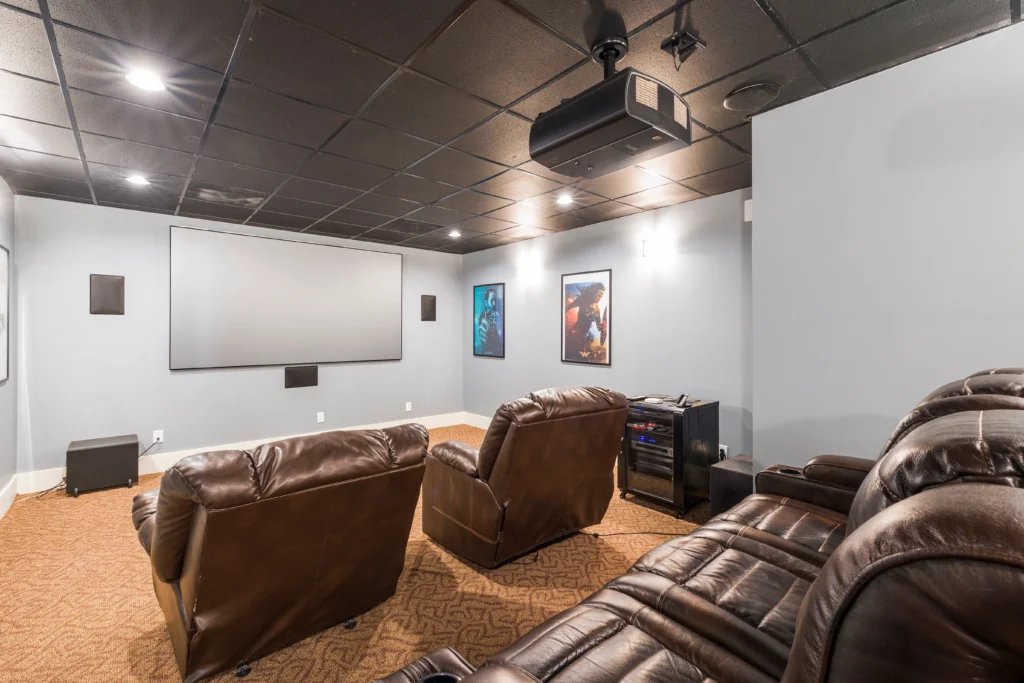
A basement’s limited daylight can make it a strong candidate for a home theater. Before you move in a big TV and comfortable couches, though, you need to address moisture, comfort, sound transfer, and electrical capacity.
Hiring a reliable general contractor in Tacoma helps protect your electronics from moisture and reduces movie sound from traveling into the rest of the house.
How Do You Build a Media Room in a Basement?
Turning a basement into a warm, quiet theater starts with preparing the concrete shell for its intended use. The right scope depends on the space, but three upgrades often make the biggest difference:
- Managing Water Intrusion: Coordinating an interior perimeter drain and sump pump where water enters at the foundation wall or floor joint.
- Blocking the Cold: Installing continuous rigid foam insulation against concrete walls, sealing the assembly, and framing a comfortable interior wall.
- Reducing Sound Transfer: Decoupling drywall with resilient channel, adding insulation, and sealing penetrations to limit movie sound from reaching upstairs rooms.
Cutting the Concrete Floor to Stop Basement Flooding
Basements in the Pacific Northwest face wet soil, heavy rain, and drainage challenges. Water can enter through foundation cracks, wall-floor joints, or poorly drained soil around the home. You cannot simply install expensive carpet over a damp concrete slab and expect it to last.
When site conditions call for it, your contractor coordinates a qualified waterproofing crew to saw-cut a trench along the inside perimeter of the slab. The specialist installs perforated drain pipe in drainage stone, routes it to a sump pit, and connects a pump that discharges water safely away from the foundation. Your general contractor manages the schedule, permits, and coordination with the plumbing and electrical work. Addressing water intrusion first protects the new flooring, walls, and equipment from moisture damage.
Blocking the Cold with Foam Wall Insulation
Bare concrete walls can feel cold and transfer heat out of the basement. If fiberglass insulation is placed directly against cold concrete, interior moisture can reach the cold surface and create condensation behind the finished wall. That moisture can support mold growth over time.
Smart builders install continuous rigid foam insulation directly against the concrete. They seal joints and penetrations, then build a framed wall in front of the foam to carry wiring, outlets, and finishes. This assembly reduces heat loss and drafts while helping keep moisture away from vulnerable interior materials. The result is a more comfortable media room and a lower risk of hidden moisture problems.
Installing Sound Tracks to Keep Movie Noise Downstairs
A good theater needs a subwoofer for deep bass. That low-frequency energy can travel through framing, floors, and wall connections into the rooms above. In a poorly isolated basement, an action movie can be clearly audible upstairs.
Adding drywall alone may not solve the problem. A skilled builder attaches resilient channel to framing before hanging drywall, creating a decoupled wall assembly. Combined with insulation, sealed penetrations, and added mass where needed, this reduces vibration transfer and makes movie sound far less disruptive upstairs. No system eliminates every sound, but a properly designed assembly keeps the theater enjoyable without turning the whole house into part of the movie.
Managing the Heavy Power Needs for Home Theaters
Modern theaters use substantial power. A large display, amplifier, subwoofers, lighting, and accessories can strain an older electrical panel or overloaded branch circuits. An electrician should calculate the expected demand before the walls close up.
A local builder coordinates licensed electricians to install dedicated circuits where appropriate and verify that the panel, wiring, and grounding can support the equipment safely. Dedicated circuits provide reliable capacity for the theater, while surge protection helps protect sensitive electronics from voltage spikes. Planning the electrical work early prevents mid-project surprises and keeps the system ready for years of movie nights.
Related Articles:
- What Seattle General Contractors Manage During Construction
- What to Ask a Seattle General Contractor Before a Remodel
Start Your Media Room with a Tacoma General Contractor
Finishing a basement goes smoothly when you handle water control and soundproofing before the drywall goes up. Top Rung Construction manages the concrete work, drainage, and heavy framing needed to turn an unfinished basement into a quiet media room.
Call Top Rung Construction to set up a walkthrough with a reliable general contractor in Tacoma.